China has become a major sourcing destination for Outdoor Party Tents, serving weddings, exhibitions, festivals, resorts, and private celebrations. Manufacturers offer varied designs, from compact garden marquees to large clear-span structures. Their capabilities may include aluminum frames, coated fabric roofs, transparent panels, flooring, lighting, and sidewall systems.
Selecting a reliable supplier requires more than comparing online prices. Experienced buyers examine fabric weight, waterproof performance, UV resistance, stitching quality, frame thickness, and anchoring options. Product samples can reveal details that photographs hide. A good factory should explain production steps clearly and provide practical documentation, including material specifications, installation guidance, inspection records, and packaging information.
Quality control matters.
Manufacturing experience also affects customization. Suppliers familiar with overseas projects often understand container loading, regional weather conditions, and site limitations. However, experience claims should be verified through factory audits, project references, video inspections, or independent testing reports. Communication is equally important when discussing dimensions, colors, printing, delivery schedules, and replacement parts.
This guide reviews China’s leading outdoor party tent manufacturers and suppliers from a practical sourcing perspective. It considers product quality, design flexibility, manufacturing capacity, service responsiveness, and long-term reliability. No supplier fits every project. A low quote may conceal thinner materials, limited accessories, or weaker after-sales support. Even detailed research cannot remove every risk, but it can make decisions more transparent and measurable. Buyers should confirm local safety requirements before installation and request a final written quotation before placing an order.
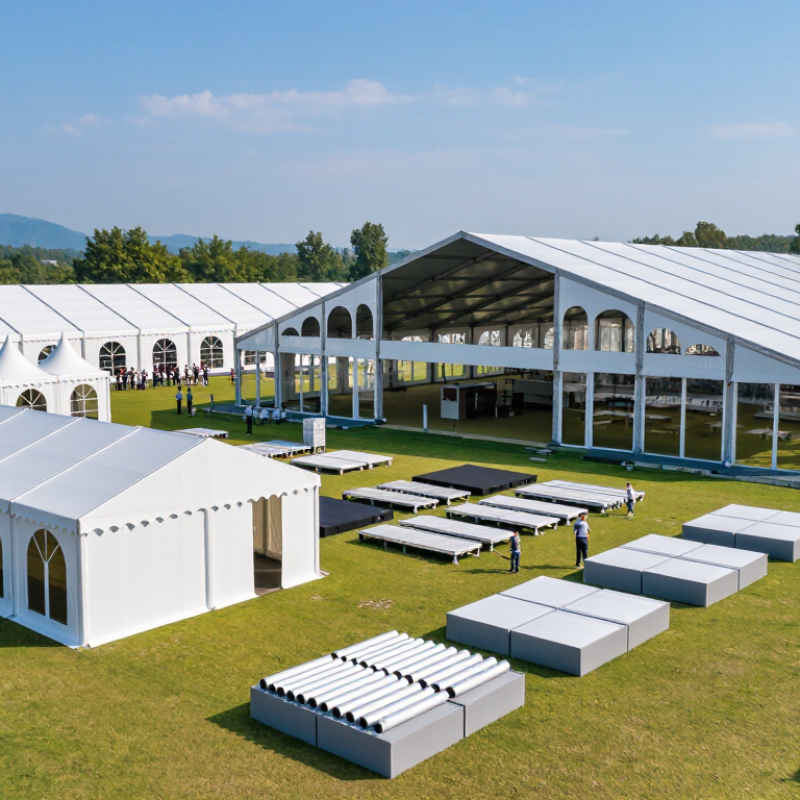
China’s Outdoor Party Tent Industry: 10–50 m Spans and Global Supply Chains
China’s outdoor party tent sector serves projects ranging from compact 10-metre clear spans to structures approaching 50 metres. That range changes the engineering brief. A 10-metre tent may use lighter frames and smaller transport bundles; a 50-metre span needs careful checks on wind loading, joints, anchoring, and roof drainage. Buyers should request drawings, fabric specifications, and load calculations—not rely on span size alone. Details matter.
The supply chain is equally practical. Aluminum profiles, steel connectors, coated fabric, and hardware may come from different production hubs before assembly and export. The World Bank’s Logistics Performance Index 2023 placed China 19th, with a score of 3.7 out of 5, reflecting broad logistics capability rather than guaranteed delivery for any single order. UNCTAD’s Review of Maritime Transport 2024 reported that global maritime trade grew 2.4% in 2023. Shipping remains exposed to route changes and schedule disruption. A packed tent can look straightforward on a loading list, yet missing pins or mixed frame sections can delay installation.
For importers, compare suppliers using the same checklist: span, eave height, fabric weight, corrosion protection, packing dimensions, and replacement-part availability. Ask for sample components and a trial assembly plan. This is not always convenient, but it can reveal weak connections before a large shipment leaves. Specifications still need scrutiny.
Party Tent Types by Structure, Capacity, and 650–900 g/m² PVC Fabric
China’s outdoor party tent manufacturers and suppliers commonly offer pole, frame, and clear-span structures. Pole tents use tensioned ropes and central supports, creating a traditional peaked profile. Frame tents stand on aluminum or steel frames, so they suit paved courtyards and tighter spaces. Clear-span designs remove interior posts, improving dining layouts and stage visibility.
Capacity should match both guest numbers and event equipment. A 6×12 metre tent may hold around 70 seated guests, depending on tables, aisles, lighting, and catering stations. Larger structures can cover weddings, exhibitions, or community events. Do not trust capacity figures alone. Ask suppliers for layout drawings, wind ratings, drainage details, and anchoring methods.
PVC fabric between 650 and 900 g/m² offers a practical range for repeated outdoor use. Lightweight 650 g/m² fabric is easier to transport, while 850–900 g/m² fabric usually feels stronger and more stable. Coated polyester, welded seams, UV resistance, and waterproof testing deserve close inspection. In practice, heavier fabric does not automatically mean better performance. Poor welding can still cause leaks. I have seen specifications look impressive, yet omit temperature limits and repair guidance. Reliable suppliers should provide material samples, production photos, inspection records, and clear replacement-part support. Check certificates against the destination’s safety requirements, because standards and weather conditions vary.
Manufacturer Standards: EN 13782, ISO 9001, Fire Ratings, and Wind Loads
China’s outdoor party tent manufacturers and suppliers should provide clear evidence of structural safety, material performance, and quality control. For temporary structures, EN 13782 offers a practical reference for design, assembly, stability, and inspection. It helps buyers examine frame connections, fabric tension, anchoring points, and emergency access before installation.
ISO 9001 indicates a controlled quality management system, but it does not automatically prove that a tent is safe. Buyers should request production records, inspection procedures, and batch traceability. Check the fabric certificate carefully. It should identify the test method, fire classification, and material sample. Fire ratings can differ by country, venue, and testing standard, so one document may not satisfy every project.
Wind loads require more than a printed number. A reliable supplier should consider local wind speed, tent size, ground conditions, ballast, and anchoring methods. Ask for engineering calculations and installation drawings. Field experience matters here. Loose straps, uneven ballast, or poorly seated joints can reduce stability quickly. Small details matter.
Inspect the frame before guests arrive. Then inspect it again after strong weather. Even experienced teams can overlook damaged stitching or shifting ballast. A certificate may also be outdated, incomplete, or unrelated to the supplied material. That is why careful document checking remains essential. Safety depends on design, manufacturing, transport, assembly, and supervision working together.
Supplier Evaluation: MOQ, 15–30 Day Lead Times, QC, and Warranty Terms
Choosing China’s top outdoor party tent manufacturers requires more than comparing catalog prices. MOQ often reveals production flexibility. A practical starting point is 50–100 units for standard sizes, while custom printing may require more. Request the exact MOQ for fabric color, frame finish, packaging, and spare parts. According to Grand View Research’s camping equipment market analysis, the sector is expanding at roughly 6% annually, increasing pressure on suppliers to deliver consistent capacity.
A 15–30 day lead time is realistic for repeat designs with confirmed materials. It may be unrealistic for new artwork, unusual dimensions, or peak-season orders. Ask for a dated production schedule, not a promise. Factory QC should include fabric weight, seam strength, waterproof testing, frame joints, and packed dimensions. SGS inspection data or an internal inspection checklist adds useful evidence. Still, paperwork alone cannot replace random pre-shipment checks.
Warranty terms need careful reading. A credible supplier should define coverage, claim deadlines, replacement procedures, and exclusions for wind, misuse, or incorrect installation. The International Organization for Standardization emphasizes documented quality processes through ISO 9001, but certification does not guarantee every shipment. My own supplier scorecards sometimes overvalue certificates. That is a mistake. Inspect one finished tent, photograph the carton, and test the locking mechanism before approving bulk production.
Top Chinese Manufacturers: Factory Audits, Customization, and Export Markets
China’s outdoor party tent sector combines large production capacity with flexible customization. The WTO World Trade Statistical Review 2024 states that China supplied 14.2% of global merchandise exports in 2023. UN Comtrade data for HS 6306 also places China among the leading exporters of textile shelters. However, export scale alone proves little.
A factory audit should check welding points, seam stitching, fabric coating, packing methods, and production records. It should also verify fire-performance documents where destination rules require them. A glossy catalog is not proof.
Reliable suppliers normally provide drawings, fabric samples, load information, and inspection checkpoints before production. Custom orders may include unusual dimensions, printed walls, reinforced corners, transparent panels, or climate-specific fabrics. Buyers should request a prototype before approving bulk production.
Small details matter. A zipper can fail first.
Independent inspection remains useful, especially when orders involve multiple workshops. ISO 9001 certification supports process control, but it cannot replace physical verification.
Export experience should be measured through accurate documentation, not vague claims. Suppliers familiar with European, North American, Middle Eastern, and Asia-Pacific markets should understand labeling, packaging, customs codes, and destination safety requirements. ITC Trade Map can help compare export records by product category and country. Yet trade databases may group different shelter products together, creating imperfect comparisons.
That limitation deserves attention.
A careful buyer should combine database evidence, factory videos, audit reports, sample testing, and recent customer references before selecting a long-term manufacturing partner.
FAQS
Suppliers may offer clear spans from about 10 metres to nearly 50 metres. A 10-metre tent usually needs lighter framing. A 50-metre structure requires deeper engineering checks.
Request engineering drawings, fabric specifications, load calculations, and installation instructions. Also ask for packing dimensions and replacement-part details. Do not rely on span size alone.
Larger spans face greater wind pressure and heavier structural demands. Check joints, anchoring, roof drainage, and frame strength. Small omissions can become expensive problems.
Use the same checklist for every supplier. Compare span, eave height, fabric weight, corrosion protection, packing size, and spare parts. A fair comparison needs matching details.
Request sample connectors, fabric pieces, pins, and frame sections. Ask for a trial assembly plan. One afternoon of testing may reveal weak connections.
No. It suggests controlled production, but it does not prove complete structural safety. Ask for inspection records, production data, and batch traceability. Documents need careful checking.
Review the fabric certificate, test method, fire classification, and sample identity. Requirements can differ by country and venue. One certificate may not fit every project.
Ask for calculations using local wind speed, tent size, ground conditions, ballast, and anchoring. Inspect straps, joints, and ballast placement during installation. Numbers alone are not enough.
Before opening, check stitching, frame joints, anchors, straps, and ballast. Inspect again after strong winds or heavy rain. A certificate cannot detect shifting ballast.
Yes. Different parts may come from separate production locations. Missing pins or mixed frame sections can stop assembly. A packed load can look complete, but it may not be.
Conclusion
China’s outdoor party tent industry has developed into a major part of the global temporary-structure supply chain, offering solutions with spans typically ranging from 10 to 50 meters. Outdoor Party Tents are available in various layouts and capacities, including clear-span structures for weddings, exhibitions, festivals, and corporate events. Many manufacturers use durable PVC-coated fabric in weights of approximately 650–900 g/m², balancing weather resistance, service life, and transport efficiency.
When selecting a Chinese manufacturer or supplier, buyers should assess structural compliance, quality management, fire-rating documentation, and wind-load performance, with EN 13782 and ISO 9001 commonly used as reference standards. Important commercial factors include minimum order quantities, typical lead times of 15–30 days, factory quality-control procedures, customization capabilities, inspection arrangements, and warranty terms. Factory audits and export experience can further help buyers evaluate production reliability, communication, and after-sales support across different international markets.
 Domi
Domi
