
Domi
Choosing a reliable China Party Tent supplier requires more than comparing catalog prices. A tent may look impressive online, yet fail during heavy rain, repeated assembly, or crowded outdoor events.
Party-tent buyers should examine fabric specifications, frame strength, stitching quality, fire-retardant documentation, and replacement-part availability. Ask for close-up photos of seams, connectors, windows, ground bars, and anchor points. A serious supplier should explain these details clearly.
As party-tent sourcing consultant Mia Chen says, “A dependable supplier proves quality through testing, transparent communication, and consistent production, not attractive photographs alone.”
That principle deserves careful attention. Request a physical sample before placing a large order. Inspect the fabric under direct light. Check whether zippers move smoothly and whether the frame joints fit without excessive force. Small defects often become expensive problems at an event site.
Factory experience also matters. Review production capacity, quality-control procedures, export packaging, and previous project references. A supplier serving rental companies may understand repeated installation better than a factory focused only on occasional sales.
Do not judge reliability from one successful conversation. Compare response times, technical answers, sample results, and warranty terms. Clarify customization, minimum order quantities, lead times, loading methods, and after-sales support in writing.
A perfect supplier does not exist. Even experienced buyers can overlook hidden costs, delayed spare parts, or unclear fabric standards. That is why a practical evaluation process matters more than a polished sales presentation.
The best choice balances product safety, manufacturing consistency, communication, and long-term service. A lower quotation may save money today, but dependable quality protects an event business tomorrow.
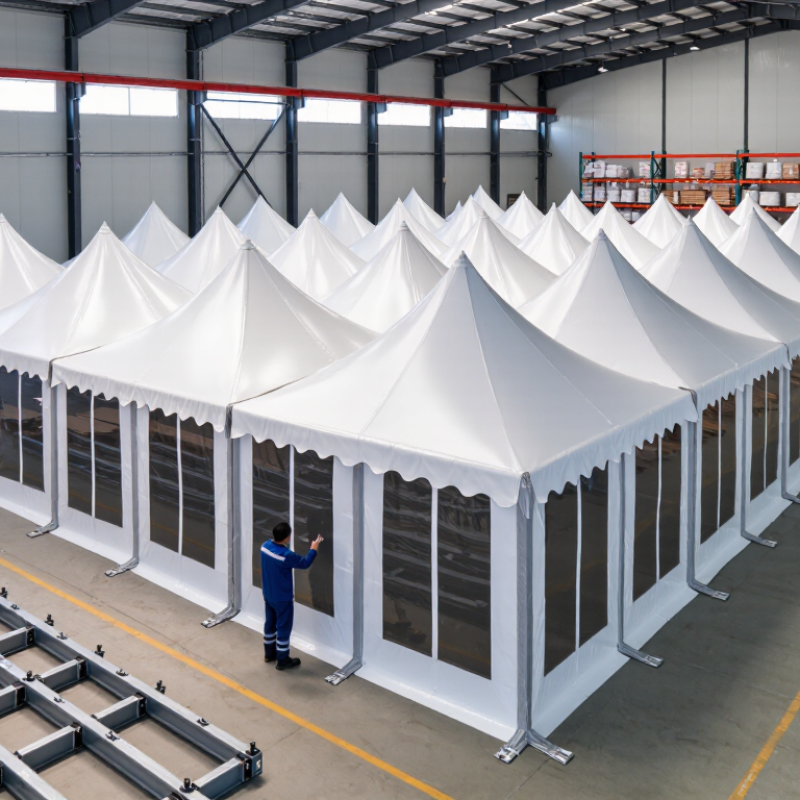
How to Choose a China Top Party Tent Supplier?
Choosing a top party tent supplier starts with three measurements: size, use case, and wind load. Do not compare catalogs too early. A 20-by-40-foot tent may suit 80 seated guests, but dining layouts need service aisles, exits, and equipment space. Measure the full event footprint, not only the guest area. I have seen buyers underestimate this by several meters. That mistake becomes expensive.
Clarify how the tent will be used. A wedding, trade display, school gathering, and temporary dining area require different layouts and materials. Ask about sidewalls, flooring, lighting points, doors, and rain drainage. For repeated rentals, inspect fabric weight, seam quality, frame joints, and replacement-part availability. Request drawings and a packing list. Details matter.
Wind load deserves technical attention. Ask for the rated wind speed, test method, anchoring plan, and allowable installation surface. Soil anchors, ballast blocks, and concrete surfaces do not behave alike. A responsible supplier should explain load assumptions in writing, not offer a vague “strong frame” promise. Compare calculation sheets, inspection records, and installation guidance. I still question simple ratings because real sites have gusts, nearby buildings, and uneven ground. A higher number is not automatically safer. Review the site with a qualified installer before ordering.
How to Choose a China Top Party Tent Supplier? Define the tent size, use case, and required wind load before comparing suppliers.
The chart shows calculated dynamic wind pressure at sea level using q = 0.613 × V², where V is wind speed in meters per second. These values are engineering reference points, not supplier certification ratings. Ask each supplier for structural calculations, anchoring requirements, and compliance with the regulations applicable to your installation site.
Typical planning dimensions: 3 × 3 m for small market stalls or receptions, 6 × 6 m for medium events, and 10 × 10 m for larger gatherings. Larger tents generally require more robust anchoring and structural verification, especially on exposed sites.
Choosing a China top party tent supplier starts with factory credentials, not attractive photos or fast replies. Ask for the current ISO 9001 certificate and inspect its scope, issuing body, factory address, and expiry date. The certificate should cover relevant manufacturing activities. Verify it through the certification body’s public database or written confirmation. Small details matter. An old address is a warning.
BSCI evidence needs careful interpretation. BSCI is a social compliance assessment, not a product-quality certificate. Request the latest assessment report, assessment date, production site, and result level. Match the legal entity on the report with the sales contract and payment details. A reliable supplier should explain corrective actions openly. Avoid accepting a cropped screenshot. One missing page can change the meaning.
Export records can test whether the factory actually serves overseas buyers. Ask for redacted customs declarations, bills of lading, or commercial invoices from recent shipments. Sensitive prices may be hidden, but dates, product descriptions, quantities, and exporter names should remain readable. Compare these records with tent samples, fabric specifications, and packing lists. If the factory claims ten years of exports but provides vague documents, pause. Credentials reduce risk, yet they never replace a production audit. Request a live video tour, inspect welding points and seam finishing, and confirm who controls final inspection. That extra check may feel slow. It can prevent expensive surprises.
How to Choose a China Top Party Tent Supplier?
When choosing a China top party tent supplier, start with material evidence, not polished product photos. A 500–650 g/m² PVC roof and wall fabric offers practical weight, weather resistance, and tear protection. However, fabric weight alone does not prove quality. Ask about the PVC structure, surface coating, UV resistance, weld strength, and cold-temperature flexibility. Request a physical sample. Check whether seams are heat-welded evenly, without thin corners or visible pinholes.
The frame deserves equal attention. 6061-T6 aluminum provides a useful balance between strength, weight, and corrosion resistance. It is easier to handle during repeated installation than heavier steel. Inspect tube diameter, wall thickness, connector fit, and the quality of drilled holes. Welding can affect the original T6 temper, so a serious supplier should explain its welding and heat-treatment process. Do not accept “6061-T6” as a complete specification. It is only one part of the frame assessment.
Look for documented load tests, material certificates, dimensional inspection records, and batch traceability. Ask how rejected fabric panels and bent frame parts are controlled. A supplier that answers clearly is easier to trust. Still, documentation can be incomplete or outdated. That is a useful warning. My preferred check is a sample tent assembled on a real site, with wet fabric, uneven ground, and several installation cycles. Small defects appear there. A zipper may pull poorly. A connector may loosen. Those details often matter more than an attractive quotation.
| Evaluation Dimension | 500 g/m² PVC-Coated Fabric | 650 g/m² PVC-Coated Fabric | 6061-T6 Aluminum Frame | Supplier Verification Checklist |
|---|---|---|---|---|
| Material Definition | Usually a polyester base fabric coated with PVC to achieve weather resistance and weldability. The stated mass is the total fabric weight per square metre. | Usually the same general construction as 500 g/m² fabric, but with a heavier coating or heavier substrate. The stated mass is also the total fabric weight per square metre. | Heat-treatable aluminum alloy containing magnesium and silicon. “T6” indicates solution heat treatment followed by artificial aging. | Request the technical datasheet, construction details, alloy designation, and material certificates for the actual production batch. |
| Nominal Mass | Approximately 500 g/m², subject to the manufacturer’s stated tolerance and test method. | Approximately 650 g/m², subject to the manufacturer’s stated tolerance and test method. | Aluminum density is approximately 2.70 g/cm³. Finished frame weight depends on profile geometry, wall thickness, connectors, and overall tent size. | Check whether fabric mass is reported before or after finishing and whether frame weight includes fittings, base plates, and connectors. |
| Typical Durability Position | Lower mass generally supports easier handling and lower transport weight. Suitable when portability is prioritized and the specification meets the required weather conditions. | Higher mass generally provides a more robust coated surface and increased resistance to handling wear, but adds weight and may increase packing volume. | 6061-T6 offers a useful combination of strength, corrosion resistance, weldability, and relatively low density for temporary structures. | Compare the complete system rather than material names alone: fabric, profile thickness, joints, anchoring, and structural calculations all affect service performance. |
| Water Resistance | Properly coated and heat-welded PVC fabric can provide a waterproof roof and wall system. Performance depends on coating quality, seams, and damage control. | Properly coated and heat-welded PVC fabric can provide a waterproof roof and wall system. The higher mass alone does not guarantee better waterproofing. | Aluminum is not the waterproof layer; water resistance comes from the fabric, welded seams, roof design, drainage, and connection details. | Request hydrostatic-pressure results, seam-leakage inspection records, and samples showing welded seams, hems, zippers, and reinforcement patches. |
| UV and Weathering | UV resistance depends on the PVC formulation, pigment, stabilizers, base cloth, and coating thickness. A declared service life should include test conditions. | May offer greater surface robustness, but UV performance still depends on formulation and testing rather than fabric mass alone. | 6061-T6 has good atmospheric corrosion resistance. Anodizing or powder coating can improve surface appearance and protection, subject to coating quality. | Ask for accelerated-weathering results, coating specifications, colorfastness information, and the expected service environment. |
| Mechanical Reference Data | Fabric tensile strength, tear strength, adhesion, and seam strength vary significantly by construction and direction. They must be confirmed by the fabric test report. | Fabric tensile strength, tear strength, adhesion, and seam strength vary significantly by construction and direction. Higher g/m² does not establish a specific strength value. | For common wrought 6061-T6 extruded products, minimum tensile strength is commonly specified around 290 MPa and minimum yield strength around 240 MPa; the exact requirement depends on the applicable product standard. | Require test reports that identify the standard, specimen direction, test method, batch, and measured results. Do not accept “6061-T6” as a substitute for a complete profile specification. |
| Frame Profile Control | Not applicable as a frame material. Fabric reinforcement should be checked at corners, tension points, and attachment locations. | Not applicable as a frame material. Reinforced hems, corner patches, and load-transfer areas should be inspected. | Profile outside dimensions, wall thickness, connector fit, straightness, hole position, and weld or joint quality directly influence structural performance. | Request profile drawings with tolerances, wall-thickness measurements, dimensional inspection records, and photographs of critical joints. |
| Seam and Connection Quality | High-frequency or hot-air welded seams are preferred for waterproof fabric assemblies when correctly controlled. | Welding parameters must be adjusted for the heavier construction to avoid incomplete fusion, overheating, or weak edges. | Bolted or pin-connected aluminum joints should provide consistent alignment and adequate load transfer without excessive play. | Review seam samples, destructive seam-test results, weld or connector inspection procedures, and a documented quality-control plan. |
| Handling and Logistics | Generally lighter and easier to fold, lift, and transport than 650 g/m² fabric. | Generally heavier and more resistant to rough handling, but requires additional labor and transport capacity. | Lightweight compared with many steels, but long profiles require suitable packaging to prevent bending, scratches, and surface damage. | Compare packed dimensions, gross weight, lifting points, protective packaging, spare-part policy, and container-loading drawings. |
| Recommended Use Consideration | Useful for applications where weight, setup speed, and transport efficiency are important, provided the project’s weather and use requirements are met. | Useful where a heavier PVC fabric construction, stronger handling resistance, or a more substantial appearance is required, provided the added weight is acceptable. | Suitable for reusable temporary structures when the profile, connections, anchoring, and structural design are properly matched to span, wind, and snow requirements. | Choose based on the intended location, maximum wind and snow loads, installation method, frequency of relocation, local regulations, and engineering documentation. |
| Best Supplier Selection Signal | A supplier that provides traceable fabric specifications, consistent mass tolerance, seam test data, and production inspection records. | A supplier that can demonstrate consistent coating thickness, welding quality, UV/weathering data, and controlled finished-fabric weight. | A supplier that provides alloy certificates, profile drawings, dimensional tolerances, structural calculations, and documented connector testing. | Prioritize transparent documentation, sample approval, third-party or in-house test evidence, corrective-action records, and a clearly defined pre-shipment inspection process. |
Important: Values shown are general engineering references and typical procurement considerations, not a guarantee for every fabric or frame. Final selection should be based on the supplier’s current test reports, applicable standards, structural calculations, local building requirements, and the tent’s intended wind, snow, UV, and operating conditions.
When selecting a party tent supplier, safety documents deserve close attention. A polished catalog is not proof of safe production. EN 13782 examines temporary structures, including stability, design, and operational safety. Ask whether the test covers your exact tent size, frame, anchoring method, and intended weather conditions. Do not accept a certificate with unclear product details.
EN 13501-1 classifies construction materials by reaction to fire. It can help assess wall fabrics, roof materials, and interior components. The classification must match the actual fabric supplied. A small material change can affect performance.
ASTM is not one single test. Request the exact ASTM method, test date, sample description, and laboratory information. CPAI-84 is especially relevant to flame performance for tent fabrics. Check whether the report covers coated fabric, seams, and finished panels, not only raw cloth.
In practical sourcing work, I look beyond logos and scanned certificates. The paperwork should identify the manufacturer, testing laboratory, sample code, and report validity.
Ask for batch traceability and production records. Visit the factory if possible. Watch how workers install anchors, tension the roof, and inspect welded joints. These details matter.
A certificate can still answer the wrong question.
I once reviewed a report for fabric that differed from the ordered specification. That gap was easy to miss. Suppliers should explain every limitation clearly. Buyers should also verify local requirements before purchase.
Safety is shared responsibility, not a document-collecting exercise.
Choosing a China top party tent supplier requires more than comparing catalog photos. I examine factory records, material samples, welding points, stitching, and packaging methods. The supplier should provide fabric weight, flame-retardant test details, frame dimensions, and corrosion protection records. A real factory audit checks production capacity, worker skills, storage conditions, and quality-control documents. Photos are useful, but they can hide weak seams or crowded warehouses. I prefer a live video inspection and a physical sample before discussing large orders. Price comparisons should use the same fabric, frame thickness, accessories, carton strength, and delivery terms. The cheapest quotation often excludes essential parts.
MOQ needs careful negotiation. Ask whether the minimum applies to each color, size, or complete order. A flexible MOQ may help new buyers test market demand, though unit pricing can rise. Inspection terms must be written clearly. AQL 2.5 should identify the inspection level, lot size, sampling plan, and defect categories. Major defects may include leaking roofs, unstable joints, or incorrect dimensions. Minor defects could involve loose threads or small printing marks. Critical safety defects should have a zero-acceptance requirement. Do not treat AQL 2.5 as permission to accept poor workmanship. Use an approved sample, measurable tolerances, and an independent pre-shipment inspection. I have seen buyers focus on carton counts and miss bent connectors inside. That mistake is expensive. Even experienced purchasers should review the inspection checklist after the first production run.
Request a current ISO 9001 certificate and verify its scope, address, issuer, and expiry date. Small details matter. An old factory address requires clarification.
Search the certification body’s public database or request written confirmation. The certificate should cover relevant manufacturing activities. Do not rely on a cropped image.
Ask for the latest report, assessment date, production site, and result level. Match its legal entity with the contract and payment details. A supplier should explain corrective actions clearly.
Request redacted customs declarations, bills of lading, or recent commercial invoices. Dates, quantities, product descriptions, and exporter names should remain visible. Compare them with samples and packing lists.
No. Credentials reduce risk, but they cannot show every production problem. Request a live video tour and inspect welding points, seams, storage, and final inspection controls.
Confirm fabric weight, flame-retardant test details, frame dimensions, corrosion protection, accessories, and carton strength. Compare equivalent specifications. The cheapest quotation may exclude important parts.
Ask whether the minimum applies to each color, size, or complete order. A flexible minimum can support market testing. However, smaller quantities may increase unit prices.
It should state the inspection level, lot size, sampling plan, and defect categories. Major defects may include leaking roofs or unstable joints. Critical safety defects should have zero acceptance.
Use an approved sample, measurable tolerances, and an independent pre-shipment inspection. Check connectors inside cartons, not only carton counts. I would review the checklist again after the first production run.
Choosing a reliable China Party Tent supplier begins with clearly defining your requirements, including tent size, intended use, expected capacity, installation conditions, and local wind-load needs. These details help you compare suppliers fairly and avoid paying for unsuitable designs. Before placing an order, verify the factory’s ISO 9001 quality system, BSCI status, production capacity, export experience, and ability to provide complete technical documentation.
Material selection is equally important. Durable 500–650 g/m² PVC fabric and 6061-T6 aluminum frames can provide a practical balance of weather resistance, strength, and service life when properly engineered. Ask for safety test reports covering EN 13782, EN 13501-1, ASTM requirements, and CPAI-84 where applicable. Finally, compare pricing alongside MOQ, lead time, warranty, and inspection procedures rather than focusing only on the lowest quotation. Clear AQL 2.5 acceptance terms, factory audits, sample approval, and pre-shipment inspection can significantly reduce quality risks and support consistent Party Tent production.
